

Retatrutide side effects: key takeaways
Retatrutide side effects are mainly gastrointestinal, and the rates generally rise with the dose. The figures below come from published trials and from Lilly press releases; last reviewed September 2026.
- In the phase 3 TRIUMPH trials, nausea affected 13.7 to 43.2 percent of participants on retatrutide versus 5.8 to 14.8 percent on placebo, depending on the study and the dose.
- The highest phase 3 nausea rate was 43.2 percent on 12 mg in TRIUMPH-4, compared with 10.7 percent on placebo.
- In phase 2, the starting dose made a large difference: on the same 8 mg target dose, nausea was 17.1 percent with a 2 mg start and 60.0 percent with a 4 mg start.
- Dysesthesia, meaning tingling or altered skin sensation, reached 20.9 percent on 12 mg in TRIUMPH-4 versus 0.7 percent on placebo.
- Heart rate rose with the dose in the phase 2 obesity trial, peaked around week 24 and then declined; in TRIUMPH-3, cardiovascular event counts did not differ significantly from placebo.
- In TRIUMPH-1 to TRIUMPH-4, 3.8 to 18.2 percent of participants stopped treatment because of side effects, versus 4.0 to 4.9 percent on placebo.
Jump to side effects by dose, heart rate and cardiovascular safety or the frequently asked questions. For the dosing schedules themselves, see the retatrutide dosage guide.
What is retatrutide?
Retatrutide (LY3437943) is an investigational once-weekly peptide from Eli Lilly that activates three hormone receptors at the same time: GIP, GLP-1 and glucagon. In the studies it is injected subcutaneously once a week.
Development targets obesity, type 2 diabetes and related conditions. The phase 3 program includes TRIUMPH-1 to TRIUMPH-4 and the TRANSCEND-T2D studies, and the retatrutide overview and TRIUMPH results cover the compound and the weight outcomes in detail. This guide focuses on tolerability. See the legal and doping status section for the approval and access situation.
How retatrutide works in the body
Retatrutide activates the GIP, GLP-1 and glucagon receptors. GLP-1 and GIP signaling reduce appetite and calorie intake, while glucagon-receptor activity adds to energy expenditure.
Preclinical research describes the molecule as balanced at the glucagon and GLP-1 receptors and stronger at the GIP receptor. A mouse study links hepatic glucagon signaling to faster PCSK9 degradation and lower LDL cholesterol, but that pathway has not been shown for retatrutide in humans.
Pharmacokinetics are dose proportional, with a half-life of about 6 days, which supports a once-weekly schedule. In the trials, gastrointestinal events are the side effects reported most often.
Most common retatrutide side effects (gastrointestinal)
Gastrointestinal events, mainly nausea and diarrhea, are the most common side effects in retatrutide trials. Nausea and vomiting generally rose from 4 mg to 12 mg, while diarrhea was similar or lower on 12 mg than on 9 mg in TRIUMPH-1, TRIUMPH-3 and TRIUMPH-4. Trial reports describe these events as mostly mild to moderate.
Nausea is the most frequent event in most trials; in TRIUMPH-3, diarrhea was reported more often (30.1 and 24.4 percent versus 21.7 and 22.4 percent for nausea). Across the four TRIUMPH trials nausea ranged from 13.7 percent on 4 mg in TRIUMPH-2 to 43.2 percent on 12 mg in TRIUMPH-4, with placebo rates between 5.8 and 14.8 percent. Constipation rose with the dose in the two trials that report it, diarrhea did not rise consistently (it was lower on 12 mg than on 9 mg in TRIUMPH-1, TRIUMPH-3 and TRIUMPH-4), and not every study reports every symptom.
Among the TRIUMPH trials, decreased appetite is reported only for TRIUMPH-4: 19.0 percent on 9 mg and 18.2 percent on 12 mg versus 9.4 percent on placebo. In the phase 2 trial in people with type 2 diabetes, mild to moderate gastrointestinal events occurred in 35 percent of participants across all retatrutide arms (67 of 190), ranging from 13 percent on 0.5 mg to 50 percent in the 8 mg arm with fast escalation, versus 13 percent on placebo.
The exact rates per study and dose are in the side effects by dose table. What the trials show about managing these events is covered under how long side effects last and what helps.
Retatrutide side effects by dose
Rates rise with the dose in most comparisons: nausea in TRIUMPH-1 was 28.6 percent on 4 mg, 38.4 percent on 9 mg and 42.4 percent on 12 mg versus 14.8 percent on placebo. A single rule does not fit every symptom, because in TRIUMPH-1, TRIUMPH-3 and TRIUMPH-4 diarrhea was lower on 12 mg than on 9 mg (clearly so in TRIUMPH-3: 24.4 versus 30.1 percent).
| Study (duration) | Dose | Nausea | Diarrhea | Vomiting | Constipation | Decreased appetite | Dysesthesia | Stopped due to side effects |
|---|---|---|---|---|---|---|---|---|
| TRIUMPH-1 (80 weeks) | 4 mg | 28.6% | 25.2% | 10.6% | 23.8% | – | 5.1% | 4.1% |
| TRIUMPH-1 | 9 mg | 38.4% | 34.1% | 22.8% | 25.9% | – | 12.3% | 6.9% |
| TRIUMPH-1 | 12 mg | 42.4% | 32.0% | 25.3% | 26.1% | – | 12.5% | 11.3% |
| TRIUMPH-1 | Placebo | 14.8% | 13.5% | 4.8% | 10.9% | – | 0.9% | 4.9% |
| TRIUMPH-2 (80 weeks) | 4 mg | 13.7% | – | 5.5% | – | – | 4.5% | 3.8% |
| TRIUMPH-2 | 9 mg | 20.8% | – | 10.2% | – | – | 5.6% | 11.6% |
| TRIUMPH-2 | 12 mg | 28.0% | – | 15.7% | – | – | 7.3% | 7.7% |
| TRIUMPH-2 | Placebo | 8.0% | – | 4.2% | – | – | 0.7% | 4.9% |
| TRIUMPH-3 (80 weeks) | 9 mg | 21.7% | 30.1% | – | – | – | 6.4% | 9.8% |
| TRIUMPH-3 | 12 mg | 22.4% | 24.4% | – | – | – | 6.4% | 13.5% |
| TRIUMPH-3 | Placebo | 5.8% | 8.7% | – | – | – | 1.3% | 4.8% |
| TRIUMPH-4 (68 weeks) | 9 mg | 38.1% | 34.7% | 20.4% | 21.8% | 19.0% | 8.8% | 12.2% |
| TRIUMPH-4 | 12 mg | 43.2% | 33.1% | 20.9% | 25.0% | 18.2% | 20.9% | 18.2% |
| TRIUMPH-4 | Placebo | 10.7% | 13.4% | 0.0% | 8.7% | 9.4% | 0.7% | 4.0% |
| TRANSCEND-T2D-1 (40 weeks) | 4, 9 and 12 mg | – | – | – | – | – | 4.5% / 2.3% / 4.4% | 2 to 5% |
| TRANSCEND-T2D-1 | Placebo | – | – | – | – | – | 0.0% | 0% |
A dash means the figure was not reported in the source. All TRIUMPH figures come from Lilly press releases (December 2025 to July 2026); peer-reviewed publications of these four trials are pending. The TRANSCEND-T2D-1 row is from the peer-reviewed Lancet publication, and values in one cell are given in dose order.
One pattern is worth stating plainly: you cannot say in general that 9 mg is better tolerated than 12 mg. In TRIUMPH-1, TRIUMPH-3 and TRIUMPH-4 more participants stopped on 12 mg, while in TRIUMPH-2 the 9 mg arm had the higher discontinuation rate.
Dysesthesia (tingling skin) on retatrutide
Dysesthesia means tingling, burning or otherwise altered skin sensation without an obvious cause. In TRIUMPH-4 it reached 20.9 percent on 12 mg and 8.8 percent on 9 mg versus 0.7 percent on placebo.
No other trial came close to the 20.9 percent on 12 mg in TRIUMPH-4: rates were 5.1 to 12.5 percent in TRIUMPH-1, 4.5 to 7.3 percent in TRIUMPH-2, 6.4 percent on both doses in TRIUMPH-3, and 2.3 to 4.5 percent in TRANSCEND-T2D-1 versus 0.0 percent on placebo. In the phase 2 obesity trial, allodynia, meaning pain from a light touch, appeared only in the 12 mg arm, in 4 of 62 participants.
In TRIUMPH-4, Lilly described dysesthesia as mostly mild and rarely a reason to stop treatment. The event appears in the trial reports as a signal of its own, separate from the gastrointestinal effects.
Retatrutide, heart rate and cardiovascular safety
In the phase 2 obesity trial, heart rate rose in a dose-dependent manner, peaked around week 24 and then declined. The TRIUMPH press releases give no heart-rate figures, and the full TRIUMPH publications are still pending.
Cardiovascular event counts are documented for TRIUMPH-3, which enrolled participants with existing cardiovascular disease. In that trial, major adverse cardiovascular events (MACE) counted with the five-component definition (MACE-5) totaled 44 on retatrutide versus 52 on placebo, with a hazard ratio of 0.82 (95 percent confidence interval 0.55 to 1.22). With the three-component definition (MACE-3), the counts were 27 versus 23, with a hazard ratio of 1.12 (0.64 to 1.96).
Both confidence intervals include 1, so neither difference was statistically significant, and the event numbers are small. TRIUMPH-3 was not designed as a cardiovascular outcomes trial; the dedicated study, TRIUMPH-Outcomes (NCT06383390), plans about 10,000 participants and runs until about 2029.
Discontinuations: how often side effects stop treatment
In TRIUMPH-1 to TRIUMPH-4, 3.8 to 18.2 percent of participants stopped because of side effects, compared with 4.0 to 4.9 percent on placebo. Per-dose rates are in the side effects by dose table.
In TRIUMPH-4, rates on retatrutide were lower among participants with a BMI of 35 or higher at baseline: 8.8 percent on 9 mg and 12.1 percent on 12 mg, versus 4.8 percent on placebo. In the peer-reviewed TRANSCEND-T2D-1 trial, 2 to 5 percent of participants on retatrutide stopped because of side effects versus none on placebo.
How long retatrutide side effects last and what helps
The phase 2 and TRIUMPH trial reports give no typical duration for stomach side effects, and the only tolerability lever they document is a slower, lower start: in phase 2, nausea reached 17.1 percent on 8 mg with a 2 mg start versus 60.0 percent with a 4 mg start. The phase 3 program starts at 2 mg and increases the dose every 4 weeks (steps of 2, 4, 6, 9 and 12 mg) up to the target dose of 4, 9 or 12 mg.
What the trials show about timing
The trial reports describe no tested protocol for managing nausea, diarrhea or other stomach side effects. The one documented time course, for heart rate, is covered under heart rate and cardiovascular safety.
The half-life of about 6 days explains the once-weekly schedule; it is a pharmacokinetic figure, not a measure of how long side effects last.
Phase 2: nausea by starting dose
| Dose arm | Nausea | Participants with nausea |
|---|---|---|
| 1 mg (direct start) | 14.5% | 10 of 69 |
| 4 mg (4 mg start) | 36.4% | 12 of 33 |
| 8 mg (4 mg start) | 60.0% | 21 of 35 |
| 8 mg (2 mg start) | 17.1% | 6 of 35 |
| 12 mg (2 mg start) | 45.2% | 28 of 62 |
| Placebo | 11.4% | 8 of 70 |
Register results for the phase 2 obesity trial (NCT04881760). The 60.0 percent figure is the 8 mg arm with fast escalation, and the comparison between the two 8 mg arms shows the starting dose, not the target dose, made the difference.
Retatrutide vs tirzepatide and semaglutide side effects
Retatrutide, tirzepatide and semaglutide differ in receptor activity: retatrutide activates the GIP, GLP-1 and glucagon receptors, tirzepatide (Mounjaro) is a GIP and GLP-1 agonist, and semaglutide is a GLP-1 agonist. No published study has yet compared their side effects head to head.
Rates from separate trials cannot be compared directly, because populations, durations and study designs differ. Two direct comparisons are underway: TRIUMPH-5 (NCT06662383) tests retatrutide against tirzepatide, with the primary completion planned for November 2026, and TRANSCEND-T2D-2 (NCT06260722) tests retatrutide against semaglutide in type 2 diabetes; its primary completion was planned for August 2026, but no results had been posted as of September 2026.
For retatrutide's weight outcomes, see the full TRIUMPH phase 3 results; the reference trials for tirzepatide and semaglutide are SURMOUNT-1 and STEP 1.
Where the retatrutide side effect data come from
Tolerability data come from two peer-reviewed phase 2 trials and the phase 3 TRIUMPH and TRANSCEND programs. Among the phase 3 trials, only TRANSCEND-T2D-1 has been published in a peer-reviewed journal as of September 2026, while the TRIUMPH-1 to TRIUMPH-4 figures come from Lilly press releases.
| Trial | Population | Participants | Duration | Source type |
|---|---|---|---|---|
| Phase 2 obesity (NCT04881760) | adults with obesity or overweight plus a weight-related condition, no diabetes | 338 | 48 weeks | peer-reviewed (Jastreboff 2023, PubMed) |
| Phase 2 type 2 diabetes (NCT04867785) | adults with type 2 diabetes | 281 | 36 weeks | peer-reviewed (Rosenstock 2023, PubMed) |
| TRANSCEND-T2D-1 (NCT06354660) | adults with type 2 diabetes | 537 | 40 weeks | peer-reviewed (Bajaj 2026, PubMed) |
| TRIUMPH-1 (NCT05929066) | obesity or overweight with a weight-related condition, no diabetes | 2,339 randomized | 80 weeks | press release (Lilly, May 2026) |
| TRIUMPH-2 (NCT05929079) | obesity with type 2 diabetes | 1,152 | 80 weeks | press release (Lilly, July 2026) |
| TRIUMPH-3 (NCT05882045) | BMI 35+, cardiovascular disease | 1,949 randomized | 80 weeks | press release (Lilly, July 2026) |
| TRIUMPH-4 (NCT05931367) | BMI 27+, knee osteoarthritis | 445 | 68 weeks | press release (Lilly, December 2025) |
TRIUMPH-1 and TRIUMPH-3 numbers are those randomized; the registers list slightly fewer participants enrolled.
Retatrutide doses in the trials: short overview
Retatrutide is an investigational drug with no authorized dosing recommendation, and the figures here are study doses or reported use, not advice. The phase 3 studies start at 2 mg once weekly and increase the dose every 4 weeks through 2, 4, 6, 9 and 12 mg, with target doses of 4, 9 or 12 mg depending on the trial.
In reported use, one supplier product page (BergdorfBio) lists 0.5 mg per week as a beginner research protocol and 2 to 12 mg per week as advanced. The 0.5 mg figure is not a phase 3 starting dose; in the phase 2 type 2 diabetes trial it was a low-dose arm given without escalation. The full retatrutide dosage chart and titration covers every dose step.
How to reconstitute and inject retatrutide: short guide
Research vials such as the retatrutide research vial contain lyophilized powder that is mixed with bacteriostatic water (10 ml) before use. For a 10 mg vial, adding 2 ml gives a concentration of 5 mg/ml.
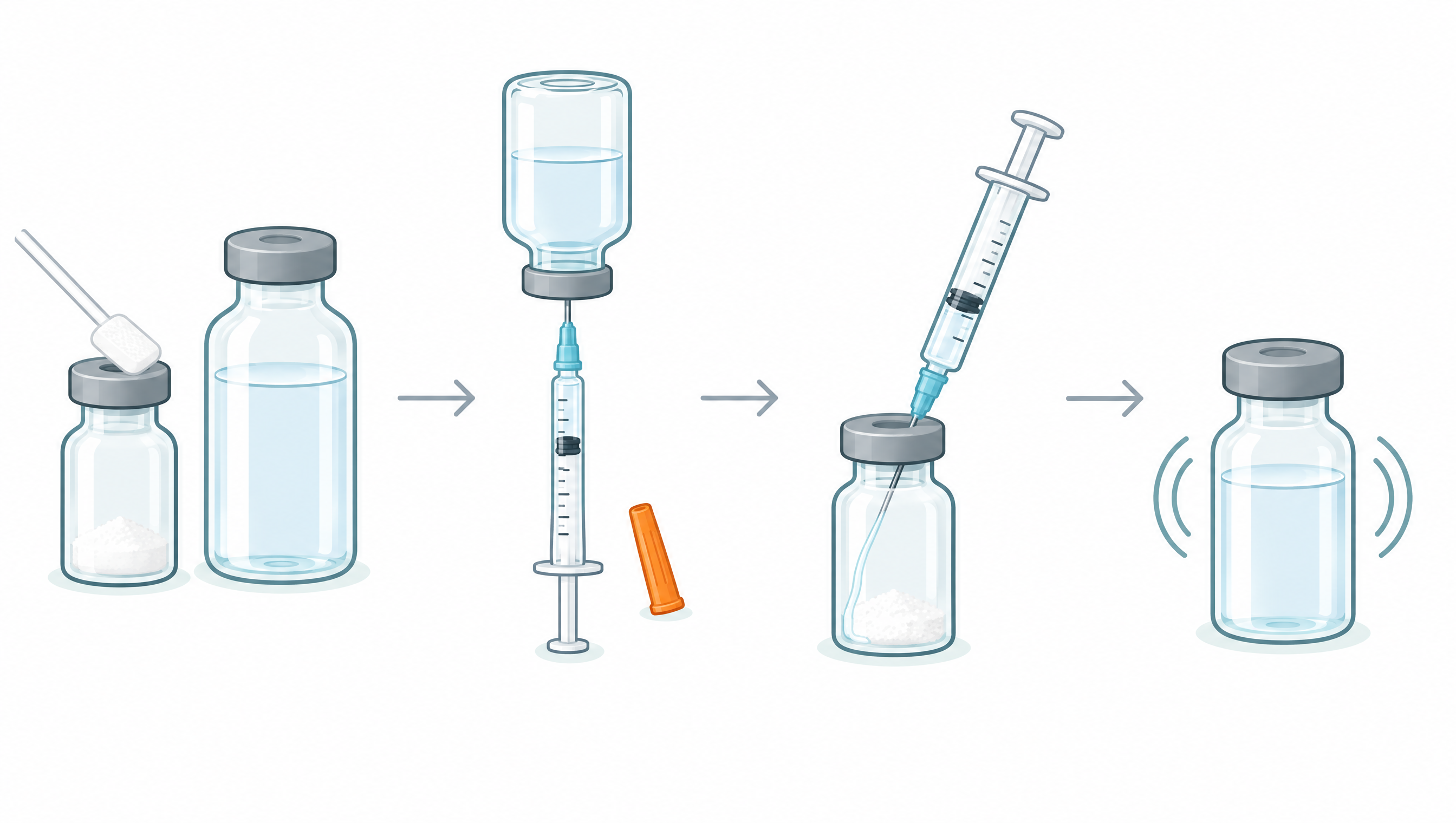
The calculation chain is short: concentration in mg/ml equals vial content in mg divided by solvent in ml; volume in ml equals dose in mg divided by concentration; units on a U-100 syringe equal volume in ml times 100. At 5 mg/ml, a 2 mg dose is 0.4 ml or 40 units, and 0.5 mg is 0.1 ml or 10 units, because one unit on a U-100 syringe is 0.01 ml. If you are unsure how much bacteriostatic water to add for other vial sizes, use the peptide calculator.
One unit on a U-40 syringe is 0.025 ml, so mixing up the U-40 and U-100 scales results in a dosing error by a factor of 2.5; the marks on the syringe are volume lines, not units of drug. Needle technique follows the FITTER 2016 and FIT UK 2019 insulin recommendations, with the shortest needles (4 mm pen, 6 mm syringe) as first choice. The step-by-step walkthrough sits in the retatrutide injection guide; for general equipment see injection supplies and injection accessories. In the studies, retatrutide is injected subcutaneously once a week.
Legal and doping status (September 2026)
As of September 2026, retatrutide is an investigational drug that no authority has approved, and it may not legally be sold or advertised for human use. Legal access runs through Lilly studies and, since June 2026, a pre-approval expanded-access program (NCT07629401) for individuals with a BMI of 35 or higher and at least two severe obesity-related conditions, when approved therapies have failed and study participation is not possible.
Lilly plans to submit its Biologics License Application to the FDA in the first quarter of 2027. The FDA has warned research-chemical sellers that retatrutide products labeled "research use only" are treated as unapproved drugs when they are offered for human use, and in August 2026 Lilly sued six sellers of retatrutide.
On the WADA Prohibited List, category S0 covers pharmacological substances without health authority approval for human use, including drugs in clinical development. The 2027 list, published in September 2026 and valid from January 1, 2027, keeps S0 in place with additional examples. Retatrutide is not named individually, but as a drug in clinical development without approval for human use it falls under the S0 definition, and S0 substances are prohibited at all times, in and out of competition. Athletes can confirm the status with NADA or Global DRO. Approved GLP-1 receptor agonists such as semaglutide and tirzepatide are not prohibited and remain in the monitoring program for 2027.
Frequently asked questions
What are the most common side effects of retatrutide?
Gastrointestinal events are the most common side effects in the trial program. Across the phase 3 TRIUMPH trials, nausea affected 13.7 to 43.2 percent of participants on retatrutide versus 5.8 to 14.8 percent on placebo, depending on the study and the dose, and the reports describe these events as mostly mild to moderate. Diarrhea, constipation and vomiting are the other frequent events, and in TRIUMPH-3 diarrhea was more common than nausea.
Is 9 mg better tolerated than 12 mg?
There is no consistent pattern. In TRIUMPH-1, TRIUMPH-3 and TRIUMPH-4, more participants stopped because of side effects on 12 mg than on 9 mg, while in TRIUMPH-2 the discontinuation rate was higher on 9 mg (11.6 percent) than on 12 mg (7.7 percent). Nausea was higher on 12 mg than on 9 mg in every trial that reported both doses.
What is retatrutide dysesthesia (tingling skin)?
Dysesthesia means tingling, burning or otherwise altered skin sensation. It is documented in the retatrutide trials: 20.9 percent on 12 mg in TRIUMPH-4 versus 0.7 percent on placebo, and 2.3 to 4.5 percent in TRANSCEND-T2D-1 versus none on placebo. In TRIUMPH-4, most cases were mild and rarely led to stopping treatment. In phase 2, pain from light touch appeared only on 12 mg.
Does retatrutide increase heart rate?
In the phase 2 obesity trial, heart rate rose in a dose-dependent way, peaked around week 24 and then declined. The TRIUMPH press releases give no heart-rate figures, and the full TRIUMPH publications are still pending, so a phase 3 heart-rate summary is not yet available.
How long do retatrutide side effects last?
The cited trial reports do not say how long individual stomach side effects last. The one documented time course is the phase 2 heart-rate response, which peaked around week 24 and then eased; separately, a 2 mg start instead of 4 mg lowered the nausea rate. The half-life of about 6 days explains the weekly schedule and is not a measure of side-effect duration.
What helps with retatrutide side effects?
The trials document one lever: starting lower and slower. In phase 2, nausea reached 17.1 percent on 8 mg with a 2 mg start versus 60.0 percent with a 4 mg start, and the phase 3 program raises the dose every 4 weeks from 2 mg. No tested protocol for managing nausea or diarrhea is described in the sources used here.
How often do people stop retatrutide because of side effects?
Across TRIUMPH-1 to TRIUMPH-4, 3.8 to 18.2 percent of participants stopped because of side effects, versus 4.0 to 4.9 percent on placebo. In TRANSCEND-T2D-1, the rate was 2 to 5 percent on retatrutide versus none on placebo. In TRIUMPH-4, rates on retatrutide were lower in the subgroup with a BMI of 35 or higher at baseline than in the full trial population.
Are retatrutide side effects worse than tirzepatide or semaglutide?
No head-to-head comparison of tolerability has been published, and rates from separate trials are not directly comparable. Two direct studies are underway: TRIUMPH-5 against tirzepatide and TRANSCEND-T2D-2 against semaglutide in type 2 diabetes; for TRANSCEND-T2D-2, primary completion was planned for August 2026 and no results had been posted as of September 2026.
Can retatrutide cause low blood sugar?
In the phase 2 trial in people with type 2 diabetes and in the phase 3 TRANSCEND-T2D-1 trial, no severe hypoglycemia was reported. In the phase 2 trial, the main side effects were mild to moderate gastrointestinal events; in TRANSCEND-T2D-1, discontinuations because of side effects ranged from 2 to 5 percent.
Is retatrutide safe? What serious risks have trials reported?
Long-term safety is not yet established: the full TRIUMPH publications are still pending, and the dedicated TRIUMPH-Outcomes trial runs until about 2029. In TRIUMPH-3, which enrolled people with existing cardiovascular disease, there were 44 major adverse cardiovascular events on retatrutide versus 52 on placebo (MACE-5) and 27 versus 23 (MACE-3); neither difference was statistically significant. The press releases report no figures for pancreatitis, gallbladder or thyroid events.
Do retatrutide trials report hair loss or muscle loss?
The sources cited here report no figures for hair loss or muscle loss. The documented events are gastrointestinal symptoms, decreased appetite, dysesthesia and allodynia, heart-rate changes, cardiovascular event counts and discontinuations. Full peer-reviewed publications of TRIUMPH-1 to TRIUMPH-4 are still pending as of September 2026.
Sources
- Jastreboff AM et al.: Triple-hormone-receptor agonist retatrutide for obesity, a phase 2 trial (NCT04881760). New England Journal of Medicine 2023.
- ClinicalTrials.gov: NCT04881760 registry results (adverse events by starting dose, skin sensation findings).
- Rosenstock J et al.: Retatrutide for people with type 2 diabetes, a phase 2 trial (NCT04867785). Lancet 2023.
- Coskun T et al.: LY3437943 from discovery to clinical proof of concept. Cell Metabolism 2022.
- Spolitu S et al.: Hepatic glucagon signaling regulates PCSK9 and LDL cholesterol (mouse study). Circulation Research 2019.
- Urva S et al.: LY3437943 phase 1b multiple-ascending-dose trial (NCT04143802). Lancet 2022.
- Bajaj HS et al.: TRANSCEND-T2D-1 (NCT06354660). Lancet 2026.
- Lilly, 23 July 2026: TRIUMPH-2 and TRIUMPH-3 topline (NCT05929079, NCT05882045), including the TRIUMPH-3 MACE figures.
- Lilly, 21 May 2026: TRIUMPH-1 topline (NCT05929066).
- Lilly, 11 December 2025: TRIUMPH-4 topline (NCT05931367).
- Lilly Q2 2026 financial results: Form 8-K, Exhibit 99.1 (BLA planned Q1 2027).
- ClinicalTrials.gov: TRIUMPH-5 (NCT06662383), retatrutide vs tirzepatide.
- ClinicalTrials.gov: TRANSCEND-T2D-2 (NCT06260722), retatrutide vs semaglutide.
- ClinicalTrials.gov: TRIUMPH-Outcomes (NCT06383390).
- ClinicalTrials.gov: pre-approval expanded access of retatrutide (NCT07629401).
- U.S. Food and Drug Administration: warning letter, Gram Peptides (31 March 2026).
- BioPharma Dive: Lilly sues sellers over black-market obesity drug (12 August 2026).
- World Anti-Doping Agency: 2027 Prohibited List (published September 2026, valid from 1 January 2027).
- IFBB: reproduction of the WADA Prohibited List (S0 non-approved substances).
- Jastreboff AM et al.: SURMOUNT-1, tirzepatide (NCT04184622). New England Journal of Medicine 2022.
- Wilding JPH et al.: STEP 1, semaglutide 2.4 mg (NCT03548935). New England Journal of Medicine 2021.
- Barrera F, Murvelashvili N: veterinarian insulin syringes (U-100 and U-40 scales). Case Reports in Endocrinology 2019.
- Frid AH et al.: New insulin delivery recommendations (FITTER). Mayo Clinic Proceedings 2016.
- FIT UK: The UK injection and infusion technique recommendations, 5th edition. 2019.

Leave a comment
All comments are moderated before being published.
This site is protected by hCaptcha and the hCaptcha Privacy Policy and Terms of Service apply.